The latest UN climate conference – COP31 – may have ended without a cover agreement between Parties but it still offered a valuable a space for dynamic exchanges and partnership building.
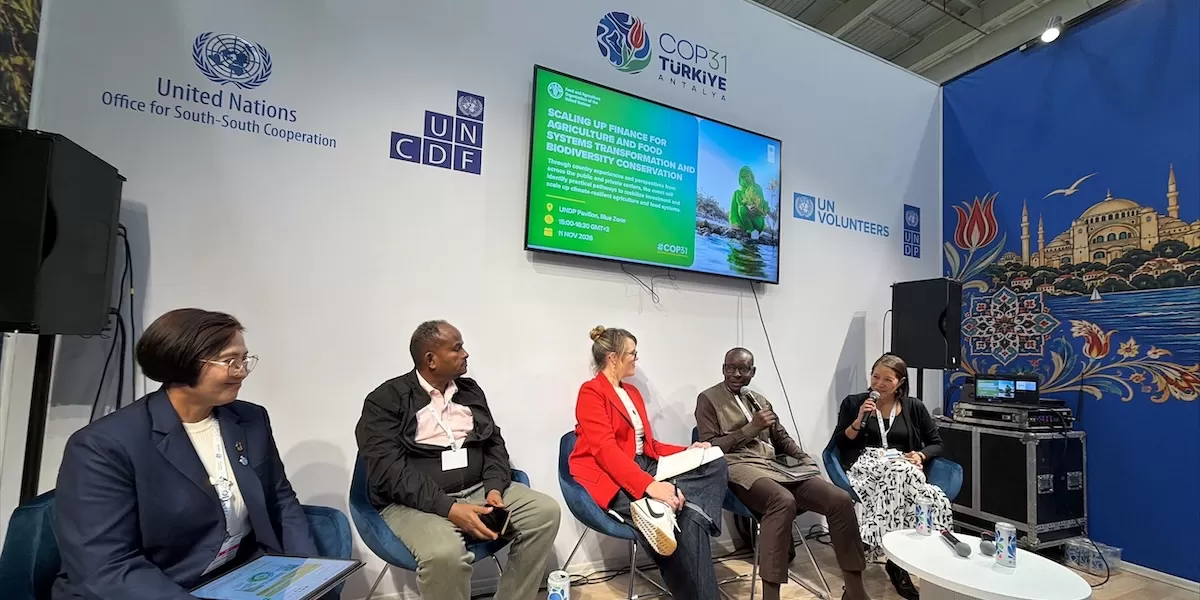
Against this backdrop, representatives from government, civil society and the private sector gathered at the UNDP Pavilion in the Blue Zone on 11 November to discuss how to scale up finance for nature-based solutions (NbS) and ecosystem-based adaptation. The side event was co-hosted by FAO and UNDP through the Scaling up Climate Ambition on Land Use and Agriculture (SCALA) programme, drawing on over ten years of collaboration to showcase country experiences of climate action in agriculture.
Farmers are already adapting to climate change, and NbS, including agroforestry and ecosystem restoration, offer promising ways to strengthen their resilience while safeguarding food security, livelihoods and biodiversity. Yet in 2022, agrifood systems received just 7.2 percent of global climate finance, or about USD 95 billion, while the annual biodiversity finance gap exceeds USD 700 billion. And, worryingly, a new FAO synthesis report finds that climate impacts on agrifood systems and vulnerable groups may be outpacing adaptation planning in Nationally Determined Contributions (NDCs).
Building on these considerations, the SCALA side event focused on one overarching question: how to scale up finance for NbS and ecosystem-based adaptation to increase climate resilience in agrifood systems.
From national plans to investment
Julie Teng, Climate Change Adaptation Specialist at UNDP, welcomed participants and moderated the session. Dr Ulf Jackel, Head of the European and International Adaptation to Climate Change Division at BMUKN, in his opening remarks highlighted the gap in financing and the role the private sector could play, as SCALA is already demonstrating.
Krystal Crumpler, Natural Resources Officer at FAO, presented public and private climate finance trends in agrifood systems, drawing on the latest NDCs, National Adaptation Plans (NAPs) and National Biodiversity Strategies and Action Plans, also presenting FAO’s new Agrifood, Biodiversity and Climate (ABC) Policy Navigator. Reyes Tirado, Global Lead for Agrifood at the Climate Bonds Initiative, then explored how to expand the climate finance toolbox for the sector, specifically explaining how green bonds could be a useful tool for countries to cover some of the climate finance gap in agrifood systems.
Country experiences
A panel brought together representatives from the governments of Cambodia, Costa Rica and Ethiopia, La Banque Agricole of Senegal, and The Rockefeller Foundation.
Ethiopia highlighted nature-based solutions as central to delivering its NDC 3.0, with landscape restoration offering benefits for food security and water recharge. With SCALA's support, six climate-smart business plans covering irrigated vegetable production, small ruminants and poultry are being implemented through six Common Interest Groups, with a particular emphasis on women's participation. SCALA has also supported the development of a legal framework for climate-smart agriculture incentives.
Senegal highlighted the challenges of developing bankable projects, managing investment risks and securing sustainable financing. With SCALA's support, La Banque Agricole developed a climate credit line, while work with women farmers' organisations in Thiès is helping build a pipeline of women-led investment opportunities worth approximately USD 1 million, combining access to finance with capacity development.
Cambodia shared its efforts to explore biodiversity credits, a financial mechanism designed to generate funding for the protection, restoration and conservation of nature. It is also aligning its National Adaptation Plan with the Global Goal on Adaptation indicators. SCALA has supported the country’s climate planning and strengthened coherence across its climate and biodiversity commitments through analysis of the alignment between the NDC 3.0, NAP and draft National Biodiversity Strategy and Action Plan.
Costa Rica presented its first payment for ecosystem services mechanism for soil carbon, launched in July 2026. The mechanism provides financial incentives to farmers for adopting sustainable soil management practices that improve soil health, increase carbon capture and storage, and deliver wider environmental benefits. Developed with SCALA's support, the mechanism covers 67 farms across 32 cantons and offers producers USD 30 per hectare annually for three years, helping incentivize investment in sustainable soil management.
The country's experiences highlighted the importance of aligning climate and biodiversity priorities, strengthening enabling policy and institutional frameworks, and developing financing mechanisms that respond to the needs of farmers and local communities. They also demonstrated how combining access to finance with capacity development, particularly for women farmers and producer organizations, can help turn climate priorities into viable investment opportunities.
Closing the session, Ms. Teng called for priorities in NDCs, NAPs and National Biodiversity Strategies and Action Plans to be translated into bankable project pipelines, building on evidence emerging from SCALA and other country-led initiatives.
Bringing SCALA’s work to other forums
SCALA was also featured in and co-led other COP31 side events, contributing to discussions on mobilizing finance for agrifood systems and biodiversity, supporting farmer-led adaptation, and translating national adaptation plans into investment for resilient food systems. SCALA also contributed to discussions on non-market approaches under Article 6.8 of the Paris Agreement. Its work was highlighted as an example of how countries can translate climate commitments into action. This was done by addressing policy, governance, information and finance gaps through coordinated government action, multi-stakeholder engagement and evidence-based decision-making.
***
This session was organized through SCALA, which supports 12 countries in Africa, Asia, and Latin America, with funding from the German Federal Ministry for the Environment, Climate Action, Nature Conservation and Nuclear Safety (BMUKN) through the International Climate Initiative. The session also drew on UNDP’s Sustainable Finance Hub work on private finance for the Sustainable Development Goals.