

A recent webinar hosted by Adaptation Accelerator Hub (AAH), led by the Government of Italy and implemented by UNDP, the NDC Partnership Support Unit and the Center for Access to Climate Finance, highlighted an important message: to mobilize the billions needed for global climate adaptation, we must move beyond planning and create a new generation of investable, scalable, and bankable opportunities for the private sector.
While impacts of climate change continue to intensify globally, finance for climate adaptation remains far below what is needed, particularly in developing countries. Current estimates indicate that climate adaptation finance flows remain in the tens of billions annually, while needs are projected to reach hundreds of billions each year, highlighting a widening financing gap that requires urgent attention.
This webinar, the second in the AAH webinar series, co-organized by Adaptation Accelerator Hub, the NDC Partnership Support Unit, and the Center for Access to Climate Finance, hosted on UNDP’s Climate Promise: Forward learning platform, focused the conversation on how to catalyze action for climate adaptation. The session framed climate resilience as a strategic growth market and positioned it as an economic opportunity and a viable area for investment. Discussions showed how countries can convert national adaptation plans into bankable opportunities capable of attracting private finance. The webinar also underscored the role of the private sector as innovators, identified necessary policy reforms, and highlighted successful case studies.
The webinar was attended by a global audience of 474 participants from 76 different countries. The event successfully convened a critical and diverse cross-section of the climate finance ecosystem, bringing together representatives from over 130 organizations that included multilateral institutions, government ministries, prominent NGOs, research think-tanks, and private sector consultancies. With an audience that represented various professional backgrounds from technical specialists and strategic leaders, the session effectively reached key decision-makers and on-the-ground innovators needed to drive scalable action in adaptation finance.
Setting the stage for the discussion, Rohini Kohli, Senior Technical Advisor at UNDP, opened the event by framing the core challenge. "As the impacts of climate change intensify, adaptation must scale at an unprecedented pace," she said. "Private engagement is limited not by a lack of interest, but by a lack of necessary investment-enabling conditions." She introduced the Adaptation Accelerator Hub (AAH) as a platform designed to bridge this "planning-to-finance" divide by transforming policy into investment-ready pipelines.
The global stage for action
Luiz de Andrade Filho, Climate Finance Coordinator for the COP30 Presidency, emphasized the elevated importance of adaptation on the global agenda. He noted that key outcomes from COP30, including the goal to triple adaptation finance, have made adaptation "fully operational and embedded in the global climate regime." This political momentum is creating the space to make adaptation a central element of resilient economies.
Echoing this sentiment, Alessandro Negrin, Senior Advisor at the Italian Ministry of Environment & Energy Security, highlighted the shift from planning to implementation. He pointed to the G7 Adaptation Accelerator Hub as a key initiative designed to "strengthen the link between national adaptation priorities and the broader financing ecosystem." He stressed that the challenge is no longer just defining priorities, but "creating the condition to turn those priorities into actionable and investable opportunities."
From strategy to investment
Prakash Bista, Manager of the G7 Adaptation Accelerator Hub at UNDP, elaborated on how the AAH helps countries navigate the "missing middle" between paper plans and investable projects. AAH provides practical support to governments to build structured pipelines of opportunities, distinguishing between actions suitable for public, private, or blended finance. A key part of this is the Hub’s Private Sector Engagement Strategy, a practical four-step blueprint that helps governments create enabling policies while defining clear entry points for businesses. The core message, Bista noted, is that "private capital follows bankable opportunities," and the AAH is designed to help countries create them.
Complementing this, Eszter Mogyorosy, Climate Finance Associate at the NDC Partnership Support Unit, emphasized the need for systemic change in how adaptation finance is designed and delivered, drawing on the recently launched Policy Brief of the Center for Access to Climate Finance, Country-Led Programmatic Approaches for Scaling Adaptation Finance in LDCs and SIDS. She underscored that country-led programmatic approaches "move beyond fragmented project-based financing models and provide a coherent structure through which countries plan, sequence, and finance investments," making them more attractive to private investors. She further noted that by aligning investments with policy frameworks, strengthening coordination, and reducing transaction complexity, these approaches improve risk allocation and enhance the overall bankability of adaptation investments.
Country spotlights: Challenges and innovations
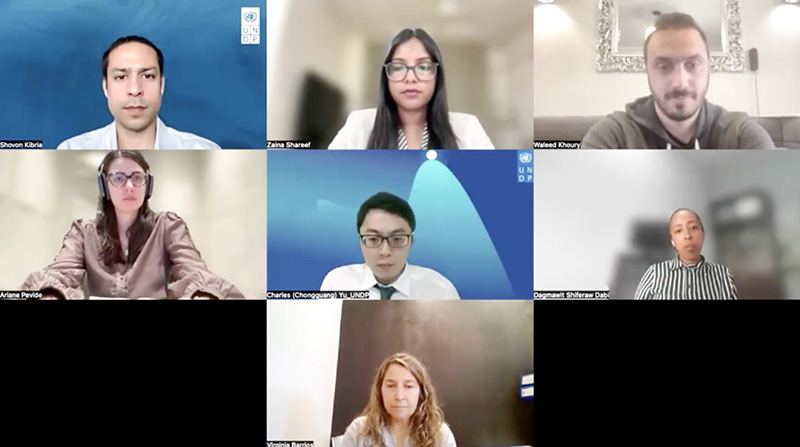
Moderated by Shovon Kibria, Private Sector Engagement Specialist, UNDP, country experiences shared during the webinar demonstrated how these principles can be applied in practice.
Dagmawit Shiferaw Dabi, Director of the Innovative Finance Lab at UNDP Ethiopia, described efforts to pilot a green bond and establish a climate-focused fund to intentionally channel capital towards climate-smart investments.
Fathimath Zaina Shareef, Principal Environment Management Officer at the Ministry of Climate Change, Environment and Energy, highlighted the nation's extreme vulnerability and the crucial role of the private sector, especially in the tourism industry.
Virginia Barrios, Head of the Territorial Planning and Management Unit in Paysandú, presented the "Adapta Fund", an innovative revolving fund for household flood-resiliences delivering adaptation finance directly to households to fund housing improvements while creating a sustainable financing loop. "This demonstrates that adaptation is not only at the level of a macro policy, but it can go down to the household level," she explained.
The investor perspective: What makes a project bankable?
A recurring theme was that unlocking private investment in adaptation depends less on the availability of capital and more on the conditions that enable it to flow. Barriers remain significant, including limited availability of climate data that can guide decisions, unclear revenue models, high perceived risks, and policy and regulatory environments that do not yet incentivize investment. Many adaptation interventions also deliver broad public benefits without generating immediate or predictable financial returns, making them less attractive to private investors without targeted support.
A panel of experts examined what it takes to move capital from "interested to invested." Ariane Pevide, Director at MUFG Bank, stressed that projects must be designed with a specific financing source in mind. "The biggest challenge... is that we find projects with high impact... but since it has not been prepared considering lending, sometimes the project team doesn't even know who would be the borrower," she explained.
Charles Yu, UNDP's Regional Lead for Sustainable Finance in Asia and the Pacific, noted that adaptation finance often involves non-traditional sectors like agriculture and water management, requiring complex cross-ministry collaboration. He highlighted UNDP's role in conducting investment mapping and feasibility studies to translate government priorities into opportunities that meet private sector requirements.
Providing an entrepreneurial view, Waleed Khoury, CEO of Sylvl Earth PBC, discussed the importance of data infrastructure and feedback loops to de-risk investments in sectors like sustainable agriculture. He emphasized that financial instruments must be dynamic enough to address the hyper-local nature of climate adaptation.
Across the discussion, a clear direction emerged: scaling adaptation finance will depend on stronger coordination across governments, financial institutions and development partners; improved alignment between public and private finance; and a shift toward integrated, country-led financing frameworks. Initiatives such as the AAH and the NDC Partnership are expected to play a catalytic role in this transition—helping countries move from ambition to implementation and from plans to pipelines. The dialogue made it clear that a coordinated effort is needed to build pipelines, apply de-risking instruments, and engage the private sector early and systematically.
As Joaquim Leite, Head of Climate Finance at the NDC Partnership Support Unit, summarized in his closing remarks, "The private capital and the private sector's mobilization is not a nice-to-have. It is essential to be able to move from ambition, from priorities, from plans, towards action on the ground." Reflecting this imperative, the NDC Partnership supports countries in strengthening investment planning, developing bankable projects, and aligning climate priorities with financing strategies, while facilitating coordination with public and private finance providers to mobilize investment for implementation.
Building on these discussions, the upcoming webinar, “De-risking Adaptation: How Public Finance Catalyzes Private Investments”, planned for September or October 2026, will further explore practical pathways to unlock private capital. It will examine the role of innovative risk‑sharing instruments and approaches to strengthening investment pipelines, while highlighting how more coordinated public and private action can help scale adaptation finance.
Led by the Government of Italy, with UNDP as the partner agency, the Adaptation Accelerator Hub (AAH) supports developing countries — particularly those most vulnerable to climate change — to accelerate climate adaptation, helping translate national priorities into bankable, finance-ready initiatives that can drive systemic, long-term resilience.
For further information please contact:
Prakash Bista, Adaptation Planning Specialist and Manager, G7 Adaptation Accelerator Hub prakash.bista@undp.org
Nisha Oswal, Knowledge Management Officer, G7 Adaptation Accelerator Hub, UNDP nisha.oswal@undp.org
Joaquim Leite, Head of Climate Finance, NDC Partnership Support Unit joaquim.leite@ndcpartnership.org
Eszter Mogyorosy, Climate Finance Associate, NDC Partnership Support Unit eszter.mogyorosy@ndcpartnership.org
EXPLORE MORE STORIES

