

Latin America and the Caribbean (LAC) is home to some of the world's most productive agricultural lands and a wealth of natural resources that are increasingly under pressure from climate change. Droughts, floods, and shifting seasons are eroding yields and livelihoods, putting food security and natural capital at risk. Luckily, there are a variety of resilience-building solutions that can help mitigate the worst impacts, while unlocking new opportunities for sustainable growth, many of which lie within the sectors most at risk: agriculture itself.
Knowledge exchange as the basis for effective climate solutions in LAC
The Scaling up Climate Ambition on Land Use and Agriculture through Nationally Determined Contributions and National Adaptation Plans (SCALA) Programme – implemented by FAO and UNDP – shows how leveraging the innovation and resilience of farmers, local and Indigenous Peoples, and public and private sector actors can bring about positive and lasting transformation, one policy, one community, one farm at a time. The recent SCALA LAC Regional Dialogue, held in May 2026 in Palmira, Colombia, at the headquarters of the International Center for Tropical Agriculture (CIAT), was the crucial for this transformative process: a dynamic, multi-stakeholder exchange designed to accelerate and improve collaboration in the final phase of a programme that is already yielding significant results across the region.
The dialogue brought together government representatives, technical experts, community leaders, and public and private sector actors from the three SCALA countries in the LAC region – Argentina, Colombia and Costa Rica – helping to deepen technical exchange and strengthening the regional alliances needed to turn national climate pledges into reality. The workshop's structure reflected the complex, interlinked nature of the challenges. A critical focus was the translation of overarching frameworks such as third generation Nationally Determined Contributions (NDCs 3.0) and National Adaptation Plans (NAPs) into actionable measures.
Headline initiatives discussed during the dialogue
Countries shared their distinct yet interconnected pathways: Colombia presented its ambitious "Potencia de la Vida" NDC, which commits to a 51 percent reduction in greenhouse gas emissions by 2030 and includes zero deforestation targets for agricultural supply chains. Argentina underscored agriculture's strategic role in its development action, with strategic lines including sustainable management of food systems, agricultural risk management and strengthened preparedness for extreme climate events.
And Costa Rica detailed its suite of five Nationally Appropriate Mitigation Actions (NAMAs) for the key sectors of coffee, livestock, bananas, rice, and sugarcane, with the livestock NAMA alone targeting a reduction of 214 Gg CO₂e by 2030 through improved livestock practices, rather than a percentage cut from current levels.
Agricultural and land-use sectors are not just significant contributors to emissions, but among the most promising arenas for mitigation and adaptation solutions that strengthen productivity, sustain livelihoods and food security and protect biodiversity. This reflects the core strength of SCALA's model, bringing together governments, the private sector, producer organizations, and local communities around a shared results, evidence and action framework, and this collaborative spirit was on full display throughout the dialogue.
People, partnerships, finance and innovation for transformation
Compelling examples of diverse partnerships and initiatives that are driving change were featured under various themes:
Innovative financing for resilience: The dialogue highlighted several promising approaches to financing climate action. In Argentina, a multi-risk insurance scheme is already protecting 530 000 hectares and 800 producers, yet most agricultural assets remain uncovered – only 0.37 percent of livestock insurance covers climate risks, revealing a massive gap. Costa Rica is expanding its long-standing Payment for Environmental Services (PES) programme — a national scheme led by FONAFIFO, mainly for forests, with over 570 000 hectares currently under contract by 2025 — into agricultural soils through the RECSOIL pilot, which currently involves 67 farms covering approximately 905 hectares. In Colombia, the BIOFIN initiative has mobilized USD 14.2 million and catalyzed a further USD 547 million for biodiversity nationally and is supporting SCALA-linked initiatives such as the Andean Bear and Water Corridor across 17 municipalities of Cundinamarca. Meanwhile, carbon markets under Article 6 of the Paris Agreement present new opportunities for mobilizing finance across the region.
Technical excellence on the ground: Concrete results from SCALA's first phase demonstrated the power of data-driven approaches. The Asociación Argentina de Productores de Siembra Directa (AAPRESID) quantified soil organic carbon improvement potential across Argentina's Pampas region, identifying gains of up to 16.5 tonnes per hectare in western Buenos Aires. Similarly, the Asociación Argentina de Consorcios Regionales de Experimentación Agrícola (CREA) analysed 1,952 cases and found that emissions intensity in maize production varies by over 100 percent between the best and worst performers – a clear signal that improved management can deliver significant climate benefits. To ensure these findings reach those who need them most, dissemination efforts have extended beyond technical reports to include podcasts and streaming content, reaching thousands of farmers and practitioners across the region.
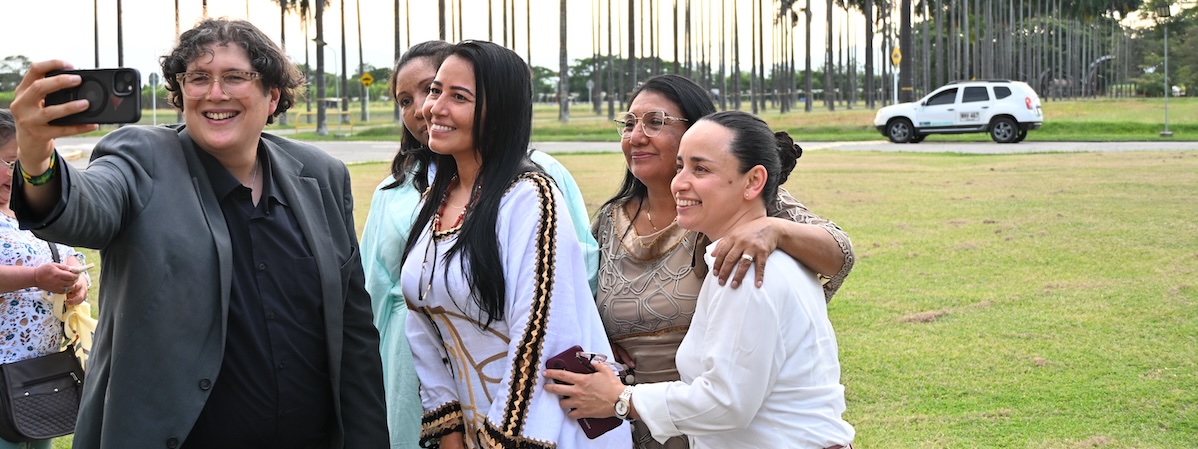
Community leadership and gender transformation: A central theme of the dialogue was the recognition that climate action must be inclusive and community driven. In Costa Rica CORFOGA's "Mujeres Ganaderas" (Women Livestock Farmers) programme, which has supported women through technical training, leadership development, productive diversification, access to certifications, and new market opportunities, exemplifies this approach. Indigenous Wayuu leaders from La Guajira and community representatives from the Sumapaz páramo in Colombia shared how SCALA complements traditional knowledge with technical capacity, empowering local communities to take ownership of climate solutions. In a special ceremony under the FAO Villages Initiative, the programme recognized the contributions of Indigenous leaders Sandra Gnecco, Leticia Bonivento, and Iris Gómez, celebrating their role as custodians of both ancestral wisdom and practical climate action.
Private sector and multi-stakeholder engagement: The dialogue underscored that transformative change requires collaboration across sectors. In Colombia, working with producers' groups, such as Fedegán, the Federación Nacional de Cafeteros (FNC), and Fedearroz, alongside more than 18 community organizations in the Chingaza and Sumapaz páramos and in La Guajira, is driving climate risk assessments, cost-benefit analyses, community climate action labs, and pilot certification for climate-adapted agriculture. In Argentina, the AAPRESID and CREA brought together producers and technical institutions to advance low-carbon models for maize and beef production. In Costa Rica, FONAFIFO, the Ministry of Agriculture and Livestock, and private actors such as Dos Pinos and ICAFE are supporting the RECSOIL mechanism and the new PES on soil organic carbon, while CORFOGA is expanding the first pilot on deforestation-free beef certification at national level. These multi-stakeholder efforts demonstrate that when governments, producers, technical institutions, and communities work together, the transition to sustainable agriculture becomes not just possible but a viable investment case.
Scaling up in a responsible, inclusive and environmentally sustainable way
The SCALA LAC dialogue concluded with strengthened country work plans for 2027, structured around four priority areas identified by participants: financing and incentives, from UNDP’s BIOFIN and private-sector mobilization to PSA schemes and carbon markets; certification and market access, including climate-adapted agriculture certification; evidence and metrics, particularly on adaptation, biodiversity, and soil practices such as RECSOIL; and responsible scaling and collaboration across institutions, sectors, and agencies.
Building on these, countries identified concrete areas for regional collaboration: financial education for producers and rural women; replication of the Women Livestock Farmers and Soil Doctors models; community-based climate action methodologies that draw on traditional knowledge, such as the Adaptation Schools and Community Climate Action laboratories; stronger linkages with regional networks on soil and climate finance; joint work with BIOFIN on biodiversity finance; and the exploration of responsible scaling methodologies.
From the grasslands and Pampas of Argentina to the semi-arid plains of La Guajira, the high-mountain areas of the páramos, and the coffee and livestock hills of Costa Rica, the Dialogue showed that SCALA's collaborative model, grounded in evidence, sound governance, and genuine partnership across sectors and borders, is what will carry regional climate commitments from paper to action, building a climate-resilient, food-secure future for Latin America and the Caribbean.