Sorry, you need to enable JavaScript to visit this website.
Skip to main content
This photo story captures how UNDP and FAO assess agriculture and water systems to build the resilience of farmer and pastoral communities.
A workshop brought together multiple stakeholders to discuss innovative climate solutions for Egypt’s National Adaptation Plan.

This Inception Report provides an overview of the preparatory steps for the implementation of the SCALA programme carried out during the inception phase in Nepal. The inception phase was complemented by key consultation and validation meetings with the focal ministry and a wider set of national stakeholders. Furthermore, the report presents the work plan for the remainder of the implementation period.
As part of translating the updated NDC/NAP priorities into actionable climate solutions, SCALA embarked on a scoping mission in Ethiopia.

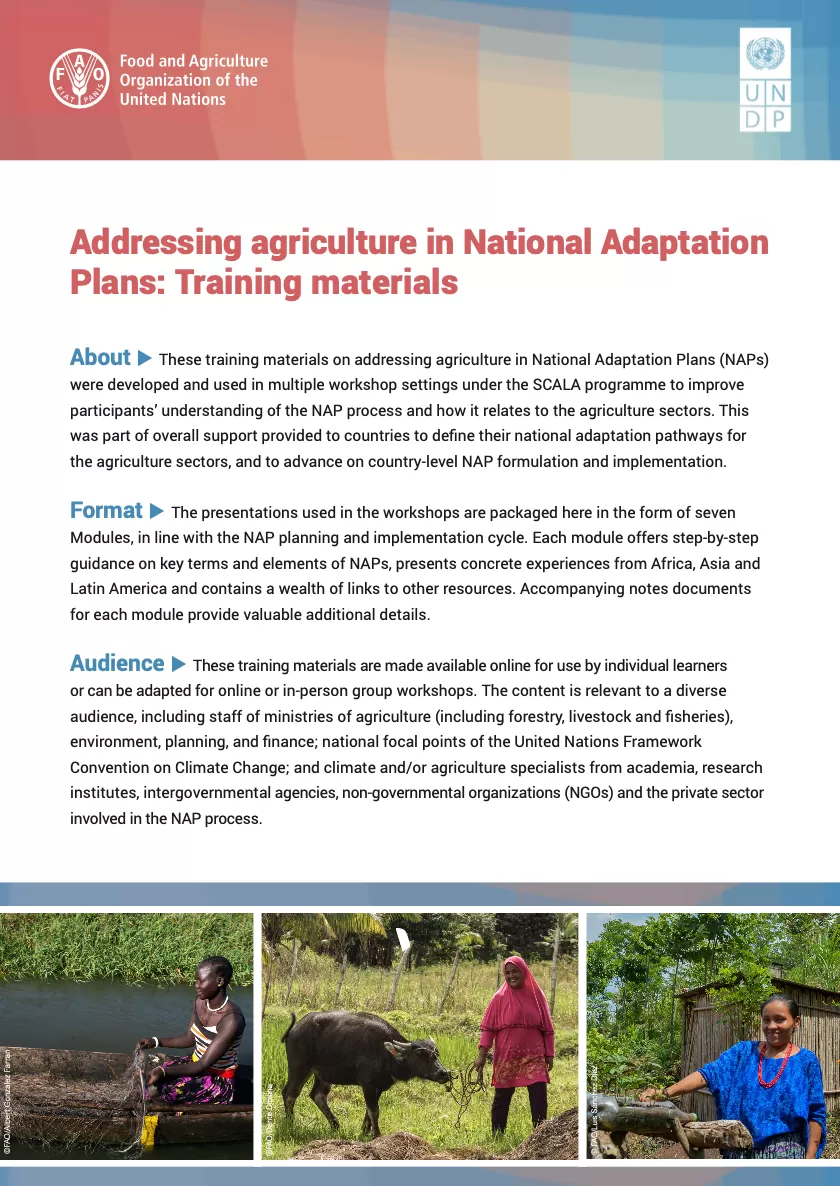
These training materials on addressing agriculture in National Adaptation Plans (NAPs) are designed to enhance the sector-specific understanding of the NAP process and advance country-level NAP formulation and implementation. It offers step-by-step guidance to move forward with the different elements of the NAP process, addressing relevant challenges through ad-hoc solutions in the agriculture sector. This set of training materials presents concrete experiences from countries across Africa, Asia, and Latin America.
As part of translating the updated NDC/NAP priorities into actionable climate solutions, SCALA embarked on a scoping mission in Ethiopia.
This event aimed to generate concrete recommendations that foster enhanced coordination, and cooperation across sectors and to promote effective climate change.
At the NAP Expo, policymakers, researchers, and stakeholders exchanged knowledge, experiences, and best practices in climate change adaptation.
This guidance note illustrates three broad intervention areas. These interventions are crucial to addressing barriers to private sector engagement (PSE) in climate action such as a perceived gap in the alignment of public and private sector objectives, a limited understanding of climate risks and business opportunities, insufficient incentives, and a lack opportunities and investable ideas that are of adequate scale which offer risk adjusted returns for their investment.